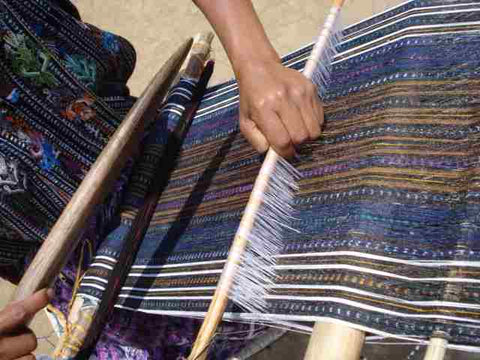
Backstrap Weaving in Guatemala
Backstrap weaving is an ancient art practiced for centuries in many parts of the world. Peru, Guatemala, China, Japan, Bolivia, and Mexico are a few of the countries where weavers use a type of backstrap loom. Today it is still used on a daily basis, in many parts of Guatemala by Mayan women, to weave fabric for their clothing and other needed household textiles such as shawls, baby wraps, tablecloths, washcloths, towels, and so much more.

The looms are simple - typically 6-7 rods- often handmade by the weaver. A backstrap loom is easily portable because it can simply be rolled up and laid aside when not in use.
The back rod is tied to a tree or post while weaving and the other end has a strap that encircles the waist or backside and the weaver can move back or forward to produce the needed tension. We carry handwoven backstrap belts in our online store.
The backstrap weaver usually sits on the ground but as the person ages that becomes more difficult and many will then use a small stool.
In the western highlands of Guatemala the women for centuries have used cotton yarn for their weaving and in some of the villages it was a custom to dye the natural cotton yarn with natural plant dyes. The women produce beautiful soft colors by dyeing their yarn with the various plant materials. They still tint yarn by hand but also buy cotton yarn that's already been chemically dyed. We carry several colors of hand dyed cotton yarn in our webstore that the artisans have dyed with these natural plant dyes.

The backstrap loom, also known as the belt loom or telar de cinteron, can make different widths of fabric depending of the width of the rods.
Guatemalan artisan weavers can weave as narrow as a belt or as large as 24 - 26 inch width and perhaps more.
Purchase a backstrap loom in our webstore.
If a cloth needs to be wider, the two pieces are joined together with heavy embroidery stitches. An example of this would be the corte (the skirt) of the Mayan women, which if hand-woven would have the pieces joined with embroidery stitches.
If you would like to learn the Guatemalan style of backstrap weaving then you need to join one of our Backstrap Weaving Tours. You will work with our artisans as they teach you how to weave with a loom you will bring home with you. Learn more about our weaving trips.
Backstrap weaving is a part of the culture of the western highlands of Guatemala. Young girls begin learning how to weave at about 7 years of age. By the time girls are ready to marry and have their own home they are extremely skilled weavers. Education And More is a Fair Trade, ethical organization and part of our mission is to educate children so we do not allow any children to work on our orders. Girls need to be in school receiving an education not working. We guarantee this!
Be sure to check out all our
weaving photos on our Flickr site.